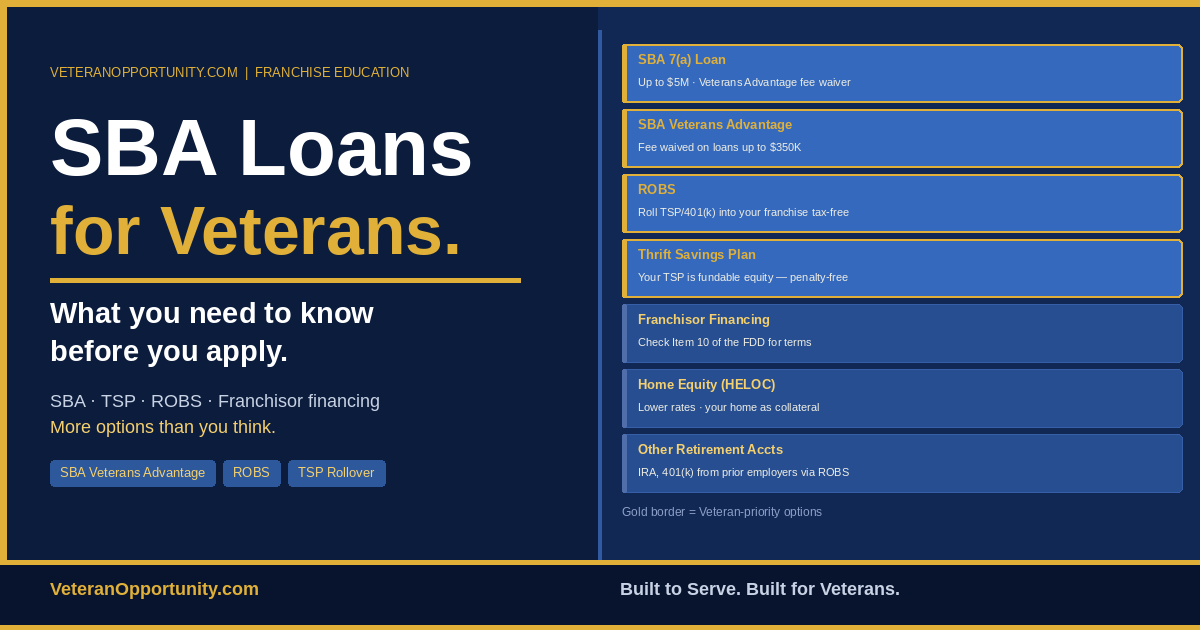
The SBA isn’t your only funding option — and for many veterans, it isn’t even the best one. Here’s the full picture before you start any application.
Money is where most franchise dreams stall.
Not because veterans can’t qualify. Not because the numbers don’t work. But because most veteran franchise buyers walk into the financing conversation knowing only one option: the SBA loan.
The SBA is a good option. For many buyers it’s the right option. But it’s one tool in a toolbox that most veterans don’t know they have — and one of the most powerful tools in that box has been sitting in your military service the entire time.
Let’s start with the SBA and work through the full picture.
What the SBA Veterans Advantage program actually is
The Small Business Administration’s Veterans Advantage program is designed to reduce the cost of SBA-guaranteed loans for veteran-owned businesses — including franchise purchases.
The primary benefit is the elimination or reduction of the upfront guarantee fee that lenders charge on SBA 7(a) loans. Depending on loan size, that fee can run into thousands of dollars. Veterans Advantage waives it entirely on loans up to $350,000 and reduces it on larger loans.
To qualify, you must be an honorably discharged veteran, active duty military eligible for the Transition Assistance Program, a reservist or National Guard member, a current spouse of any of the above, or a widowed spouse of a service member who died in service or from a service-connected disability.
The SBA 7(a) loan — the most common vehicle for franchise financing — can fund up to $5 million. For most franchise purchases, you’re looking at a loan in the $150,000 to $500,000 range depending on the brand, the market, and your total investment requirement.
What lenders actually look for
Getting approved for an SBA loan isn’t just about being a veteran. Lenders evaluate several factors regardless of your service status.
Credit score. Most SBA lenders want to see a minimum score of 650, with 680 or higher giving you significantly more options and better terms. Pull your credit report before you start any franchise conversations and address anything that needs fixing.
Liquidity. Lenders typically want to see that you have 10 to 20 percent of the total project cost available in liquid assets after the loan closes. If you’re borrowing $300,000, they want to know you still have $30,000 to $60,000 in accessible cash. This is the working capital cushion that tells them you can survive the first few months of operation.
Collateral. SBA loans are often collateralized by business assets first, personal assets second. If you own a home, it may be required as collateral on larger loans. Understand this going in.
Franchisee track record. One advantage of buying a franchise over starting an independent business: the SBA maintains a Franchise Registry of pre-approved systems. If the brand you’re buying is on that registry, the loan process is faster because the franchisor’s FDD has already been reviewed. Ask your franchisor whether their system is SBA-registered.
Business plan. You need one. It doesn’t have to be a hundred pages, but it needs to show the lender that you understand the business model, the market, the revenue projections, and how the loan gets repaid. If you need help building it, that’s something Helgerson Franchise Group can work through with you.
The Thrift Savings Plan: the funding source hiding in plain sight
Here’s the one most veteran franchise buyers miss entirely.
If you served long enough to accumulate a Thrift Savings Plan balance, that money can be used to fund a franchise — without taking a taxable distribution, without paying early withdrawal penalties, and without borrowing against it.
The mechanism is called a ROBS — a Rollover for Business Startups.
A ROBS is a legal structure, established by the IRS, that allows you to roll your TSP (or any qualifying retirement account — 401(k), IRA, former employer retirement plans) into a newly formed C-corporation, which then uses those funds to purchase a franchise or invest in a business.
Done correctly, it is not a loan. There is no monthly payment. There is no interest. The money that was sitting in your TSP — growing tax-deferred — is now working as equity in your business instead.
Here’s the basic structure:
- A new C-corporation is formed.
- The C-corporation establishes a qualified retirement plan.
- Your TSP funds roll into the new corporate retirement plan — tax-free, penalty-free.
- The plan purchases stock in the C-corporation.
- The corporation uses those funds to buy the franchise or cover startup costs.
The result: you’ve invested your retirement savings into your own business without triggering taxes or penalties at the time of the transaction.
What to know before you pursue a ROBS:
It is not a DIY project. You need a ROBS administrator — a firm that specializes in setting up and maintaining these structures — because the IRS requires ongoing compliance: annual filings, plan administration, and correct documentation. The cost is typically $3,000 to $5,000 to set up and $1,000 to $2,000 per year to maintain.
It is not risk-free. Your retirement money is now in your business. If the business fails, that capital is at risk. This is a real consideration and one you should think hard about with a financial advisor before proceeding.
It works well in combination. Many veteran franchise buyers use a ROBS to cover the equity injection required by an SBA lender — rather than depleting liquid savings, they roll their TSP to meet the down payment requirement, then fund the balance with an SBA loan. The two structures complement each other.
Other financing options worth knowing
Franchisor financing. Some franchise systems offer in-house financing or have preferred lending relationships that can accelerate approval and reduce documentation burden. Item 10 of the FDD will tell you whether the franchisor offers financing. If they do, compare the terms carefully against SBA options.
ROBS with non-TSP retirement accounts. You don’t have to use your TSP. Any qualifying retirement account — a 401(k) from a previous civilian employer, a traditional IRA — can be rolled into a ROBS structure the same way. If you have multiple retirement accounts from different jobs, they can often be combined.
Home equity. If you own a home with equity, a home equity line of credit can fund part or all of a franchise investment. Interest rates are typically lower than SBA rates, and there’s no SBA approval process. The downside: your home is directly on the line. Most franchise advisors recommend using home equity as a supplement, not the primary source.
Veteran-specific grants. There are a small number of grant programs specifically for veteran entrepreneurs. They are competitive, often limited in dollar amount, and not reliably funded year to year. They’re worth researching but shouldn’t be counted as primary funding.
Friends and family. It works. It complicates relationships. If you go this route, treat it as a formal investment with documented terms — not a handshake agreement.
The honest conversation
Financing a franchise is not complicated, but it requires honest self-assessment before you start.
Know your credit score. Know your liquid assets. Know what’s in your TSP and other retirement accounts. Know what your home equity looks like if it’s relevant. Build that picture before you talk to a franchisor, because the first question any serious brand will ask is whether you’re financially qualified.
Going in with that picture ready signals that you’re a serious buyer. It also tells you which funding path makes the most sense for your situation — because the right answer isn’t the same for every veteran.
If you’re in the early stages of evaluating franchise opportunities, the MOS Franchise Finder on this site is a good starting point for narrowing the field. And if you want a guide through both the franchise selection and the financing process, Helgerson Franchise Group works with veteran buyers from first conversation to signed agreement.
The money is there. For most veterans, more of it is accessible than they realize — including the money that’s been sitting in that TSP account since your first deployment.
Important disclaimer
The financing information in this post including information about SBA loans, ROBS structures, and Thrift Savings Plan rollovers is provided for general educational purposes only and does not constitute legal, tax, or financial advice. Franchise financing is complex, and IRS compliance requirements for ROBS structures in particular are specific and subject to change.
Before pursuing any financing strategy, consult with a qualified attorney, CPA, and/or a ROBS specialist firm experienced in franchise funding. Companies such as Guidant Financial, Benetrends Financial, and FranFund specialize in veteran franchise funding and ROBS administration and can help ensure your structure meets current IRS compliance standards.
VeteranOpportunity.com and Helgerson Franchise Group are not financial advisors, tax advisors, or legal counsel. Nothing in this post should be construed as a recommendation to pursue any specific financing strategy without independent professional guidance.
About the author
Lonnie Helgerson, CFE, is the Editor-in-Chief of VeteranOpportunity.com, where he writes about veteran entrepreneurship, franchising, small business ownership, and leadership. A U.S. Army veteran and author, he has founded six franchise systems, served as Chairman of the IFA VetFran Committee, and spent more than 35 years helping businesses grow. He is the author of Five Pennies and Buying a Franchise: Is It Right for Me? He also advises franchise brands through Helgerson Franchise Group.