The numbers have been trending in one direction for thirty years. Here’s where veteran franchise ownership stands today — and what the data tells us about where it’s going.
I’ve been in franchising for more than 35 years.
I’ve watched veteran franchise ownership go from a niche conversation to a mainstream data point that every serious franchisor tracks. The trajectory has been consistent. The numbers keep moving in the right direction.
But “veterans are great franchisees” is easy to say. Let me show you what the data actually looks like in 2026.
The headline numbers
Start here, because these are the numbers worth knowing cold.
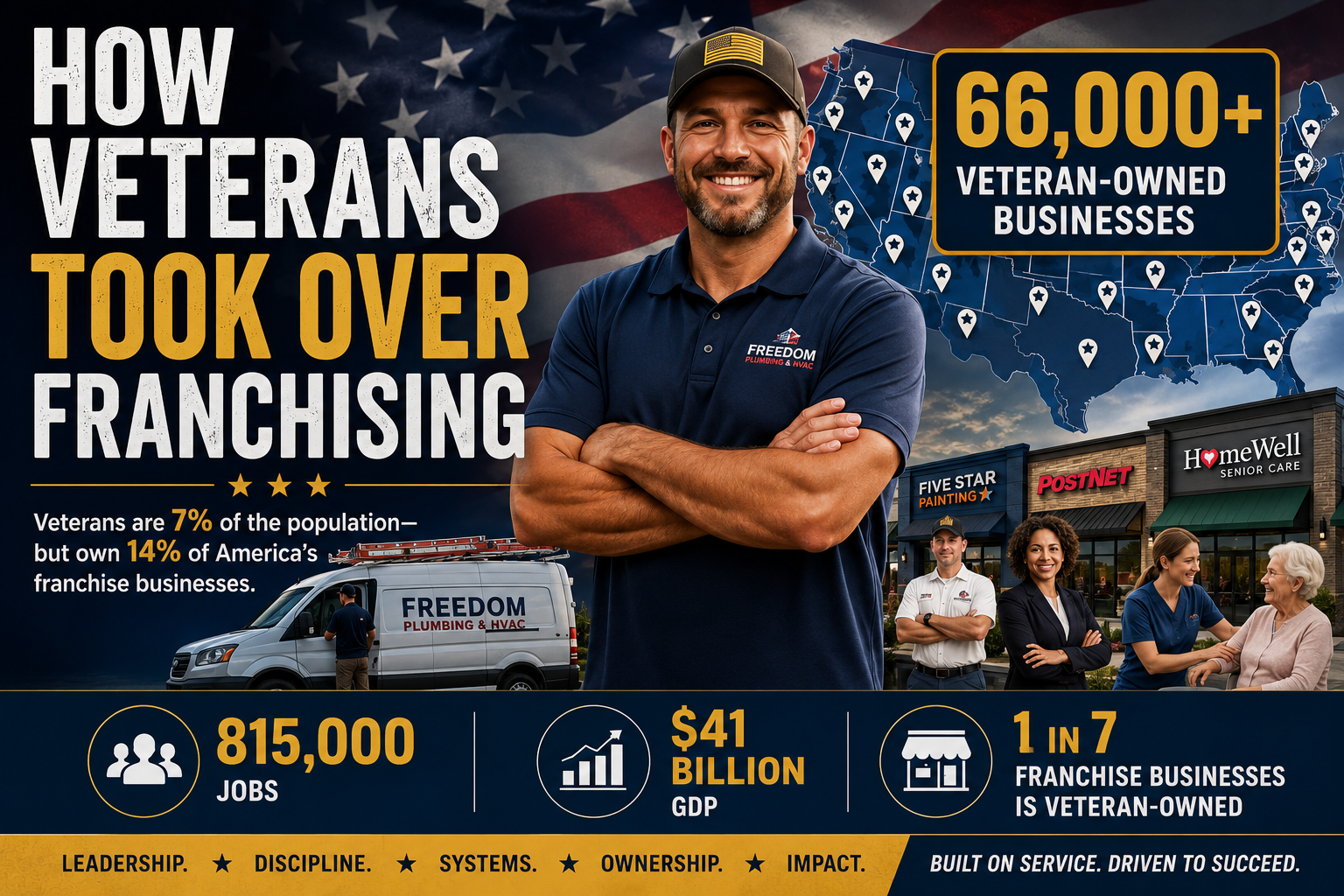
Veterans make up approximately 7% of the U.S. adult population. They own 14% of all franchise businesses in America. That’s according to research commissioned by the IFA Educational Foundation based on U.S. Census data — not a survey, not an estimate, but Census-level data.
One in seven franchise businesses in the United States is veteran-owned.
Dig deeper and the picture gets more impressive. More than 66,000 veteran-owned franchise businesses in the U.S. directly provide jobs for 815,000 Americans and generate more than $41 billion in GDP.
Read that again. 66,000 businesses. 815,000 jobs. $41 billion.
That’s not a community benefit program. That’s a major economic force — built on the skills the military develops and the franchise model enables.
The franchisor side of the equation
97% of franchisors say veterans are a good fit as franchisees. Not most franchisors. Not the veteran-friendly ones. 97% across the board.
65% of franchisors noted their overall number of veteran hires has increased in recent years. The trend is accelerating, not plateauing.
70% of franchise companies actively hire veterans.
These numbers matter because they tell you something about the market you’re entering. Veterans aren’t a charity case for franchisors. They’re a preferred candidate profile. The brands on VeteranOpportunity.com aren’t offering VetFran discounts out of goodwill — they’re competing for veteran buyers because veteran buyers produce results.
Where veterans are choosing to invest
According to Vetrepreneur data on veterans who completed franchise coaching in 2025, 77% of veterans chose one of three industries: home services (34%), business services (26%), or senior care (17%).
Home services at 34% is no surprise to anyone who’s watched this space. HVAC, plumbing, cleaning, restoration, landscaping — these are businesses built on operational discipline, systematized service delivery, and team leadership under pressure. The military builds all three.
Business services at 26% reflects a growing trend: veterans leveraging their leadership and administrative backgrounds into B2B franchise models — staffing, consulting, marketing services, commercial cleaning. These businesses don’t require a retail location, often have lower startup costs, and reward relationship-building and professional credibility.
Senior care at 17% is the one I find most meaningful. Veterans who spent their careers in service to others — often under difficult conditions — bring a genuine orientation toward care that shows up in how they run these businesses. Senior care franchises with veteran owners consistently report strong employee retention and client satisfaction scores.
Where it started — and how far it’s come
I want to give you some context that most people writing about VetFran don’t have.
I was asked to serve on the inaugural VetFran formation committee. I was there before any of this grew to where it is today.
Here’s what VetFran looked like when it was re-initiated in 2003, pulled directly from the old IFA website at the time:
“Since it was re-initiated in 2003, VetFran, formally known as the Veterans Transition Franchise Initiative, has enabled more than 400 former military servicemen and women to acquire a franchised small business. Nearly 200 companies that are members of the International Franchise Association participate in the voluntary effort, which was created to aid veterans in joining the free enterprise system through franchise ownership.”
400 veterans. 200 participating companies.
In 2007, the IFA Executive Committee and Board of Directors formalized the effort by approving the creation of a full standing committee — The VetFran Committee — with a defined mission: to increase the acquisition of franchises by honorably-discharged military veterans by offering financial incentives.
I was a member of that original 2007 committee. Two years later, I was elected Chairman. Here’s the official roster as it appeared on the IFA website in 2009:
Chairman: Lonnie Helgerson, CFE, President, IDENT-A-Kid Services of America
Vice Chairman: Mary Thompson, CFE, President, Mr. Rooter
Ron Berger, Figaro’s Italian Pizza — Ryan Cunningham, Javelin Solutions — Scott Denniston, NaVOBA — Janice M. Dwyer, CFE — Marisa D. Faunce, Plave Koch PLC — John Francis, PostNet — Christine Galli, Technology in a Box — Nancy Ghanem, NG Franchise Services — Clint Lee, Wing Zone — Mark Liston, CFE, Valpak — Chris Loudermilk, The Dwyer Group — Bret Lowell, CFE, DLA Piper — G. Thomas MacIntosh, Krass Monroe — Joseph McCord, Steak-Out Franchising — Steve Olson, Franchise Update — H. Scott Pressly, CFE, Van New Capital Advisors — Michael H. Seid, CFE, Michael H. Seid & Associates — Jerrod Sessler, HomeTask Handyman — Chuck Southern, Center for Veterans Enterprise — Phil Trigg, AcquireWeb — Marcea Weiss, NaVOBA.
IFA Staff Liaison: Terry Hill, Vice President Publishing.
That’s 23 committee members representing franchisors, franchisees, attorneys, lenders, publishers, and veteran advocacy organizations — all working on the same mission.
Today: 66,000+ veteran-owned franchise businesses. 650+ participating brands. $41 billion in GDP contribution.
I’ve watched this grow from a small committee of people who believed veterans deserved a better pathway into business ownership — into one of the most significant veteran economic programs in the country. That didn’t happen by accident.
650+ brands and counting
More than 650 military-friendly brands actively recruit former service members as owners. That number has grown steadily since VetFran was founded in 1991. Veterans are nearly three times more likely to own a franchise than non-veterans, according to Franchise Business Review.
The discounts are real and worth capturing. Most VetFran brands offer reductions of 10% to 25% on the initial franchise fee. But as I’ve said before: a VetFran discount doesn’t make a bad franchise good. Use it to reduce entry cost on a brand you’ve already vetted — not as a reason to choose a brand you haven’t.
Why the trend keeps accelerating
Roughly 200,000 service members leave the military every year. Each new cohort includes people at the right stage of life to evaluate franchise ownership seriously. The infrastructure — VetFran, SBA Veterans Advantage, ROBS structures, veteran-specific consultants — is more developed than it’s ever been. And the outcomes data keeps compounding: franchisors who’ve had strong results with veteran owners recruit more veteran owners.
What it means for you
If you’re a veteran considering franchise ownership, the 2026 data tells you something important: you’re not a pioneer. You’re joining a community of 66,000 business owners who’ve already proven the model works for people with your background.
The question isn’t whether veterans can succeed in franchising. That’s been answered definitively. The question is which franchise fits how you’re specifically built — your MOS, your experience, your financial position, your market.
That’s exactly what the MOS Franchise Finder on this site is designed to help you answer. The numbers are on your side. The brands are recruiting. The infrastructure exists.
The only variable left is you.
Lonnie Helgerson, CFE, is a U.S. Army veteran, founder of VeteranOpportunity.com, and founder of Helgerson Franchise Group. He has 35+ years in franchising, founded six franchise systems, and served as two-time chairman of the IFA VetFran Committee (February 2009 – February 2011). He is the author of Five Pennies and Buying a Franchise: Is It Right for Me?
Want to Go Deeper?
If you’re serious about franchise ownership, these two books will give you a significant head start.
Five Pennies: Ten Rules to Successfully Build a Franchise Mega-Brand — Written for franchisors and anyone who wants to understand how great franchise systems are built from the inside out. If you want to know what separates a franchise that scales from one that struggles, this is the read.
Buying a Franchise: Is It Right for Me? — The buyer’s guide written specifically for people evaluating franchise ownership. Covers what to look for, what to avoid, and how to research a franchise the right way before you sign anything.
Both are available on Amazon.