You’ve read a technical manual cover to cover to keep a piece of equipment mission-ready. You’ve decoded an operations order under a red lens at 0200. You’ve maintained aircraft on a flight line in the dark. You’ve navigated a ship through a channel with nothing but a chart and a compass. You’ve written maintenance logs, incident reports, and after-action reviews that had to be precise — because imprecision had consequences.
Regardless of your branch, your MOS, your rating, or your AFSC — the military trained you to read complex information, extract what matters, and act on it.
You can handle a legal document.
But the FDD — the Franchise Disclosure Document — stops a lot of smart, capable people cold. Not because it’s complicated. Because it’s designed to feel complicated. Twenty-three items. Hundreds of pages. Footnotes inside footnotes.
Here’s the truth: most of it is boilerplate. A handful of items are the ones that actually matter. And once you know which ones to focus on, the FDD becomes one of the most powerful due diligence tools you’ll ever use.
Let me walk you through it.
What the FDD is — and why it exists
The FDD is a legal disclosure document that every franchisor in the United States is required by the Federal Trade Commission to give prospective franchisees before any money changes hands. You must receive it at least 14 calendar days before you sign a franchise agreement or pay any fees.
That 14-day waiting period exists for a reason. Use it.
The FDD doesn’t tell you whether a franchise is a good investment. It doesn’t tell you whether you’ll succeed. What it does is give you a standardized set of information — the same 23 items, required of every franchisor — so you can compare brands, identify red flags, and ask better questions before you commit.
Think of it as a pre-mission intelligence brief. It doesn’t make the decision for you. It makes you dangerous in the conversation.
The 23 items — what actually matters
Every FDD has 23 items. Here’s a plain-English breakdown of each one, and which ones deserve your full attention.
Item 1: The Franchisor Who they are, how long they’ve been in business, what they do. Background on the parent company and any affiliates. Read it, but don’t obsess over it — it’s mostly introductory.
Item 2: Business Experience The backgrounds of the franchisor’s executives and directors. Look for franchise experience here. If the leadership team has never operated a franchise system before, that’s worth noting.
Item 3: Litigation Read this carefully. Any pending or past litigation involving the franchisor or its officers. A lawsuit or two over a long operating history isn’t unusual. A pattern of franchisee lawsuits — especially suits alleging fraud, misrepresentation, or failure to support — is a serious red flag.
Item 4: Bankruptcies Any bankruptcy history for the franchisor or its principals. Not automatically disqualifying, but you want to know about it.
Item 5: Initial Fees What you pay upfront. The initial franchise fee, plus any other fees due before you open. This is one component of your total investment — don’t confuse it with the full picture.
Item 6: Other Fees Read this carefully. Ongoing royalties, marketing fund contributions, technology fees, training fees, transfer fees, renewal fees. This is where the real cost of ownership lives. A low franchise fee can be misleading if the ongoing fee structure is punishing.
Item 7: Estimated Initial Investment Read this very carefully. The full range of startup costs — from franchise fee to equipment, real estate, working capital, and everything in between. This is presented as a range (low/high). The low number is rarely the real number. Build your plan around the midpoint or higher. And always plan for more working capital – six months to a year is what I advise.
Item 8: Restrictions on Sources of Products and Services What you’re required to buy, and from whom. Some systems require you to buy supplies from approved vendors at set prices. That affects your margins. Know it going in.
Item 9: Franchisee’s Obligations A table summarizing your obligations as a franchisee — training, site selection, operations, marketing, and more. Good reference document.
Item 10: Financing Whether the franchisor offers any financing. Most don’t. If they do, read the terms carefully.
Item 11: Franchisor’s Assistance, Advertising, Computer Systems, and Training What support you actually get. Training program length and format, field support, marketing co-op, technology systems. This is where the brand’s value proposition either holds up or doesn’t. Compare this across franchisors when you’re evaluating options.
Item 12: Territory Read this carefully. What protected territory you receive — or whether you receive one at all. Some systems grant exclusive territories. Others don’t. Some grant territory protection for the physical location but allow the franchisor to sell online or through other channels in your backyard. Understand exactly what you’re buying.
Item 13: Trademarks The brand’s trademark registrations. You want a federally registered trademark, not just a state registration or a pending application. You’re licensing the brand — make sure it’s protected.
Item 14: Patents, Copyrights, and Proprietary Information Any intellectual property you’ll be using. Less critical for most service-based franchises, more important for food or product-based systems.
Item 15: Obligation to Participate in the Actual Operation Whether you’re required to be an owner-operator or whether semi-absentee ownership is permitted. Know this upfront — it affects your entire business model.
Item 16: Restrictions on What the Franchisee May Sell What you can and can’t sell. Some systems allow add-ons; others lock you strictly to the approved product and service list.
Item 17: Renewal, Termination, Transfer, and Dispute Resolution Read this very carefully. How long the franchise term runs. What happens at renewal — and whether renewal is guaranteed. Conditions under which the franchisor can terminate your agreement. How disputes are handled (arbitration vs. litigation, and where). This item protects your investment. Don’t skim it.
Item 18: Public Figures Any celebrities or public figures associated with the brand. Usually not relevant to your decision, but worth a glance.
Item 19: Financial Performance Representations This is the one everyone asks about — and the one that requires the most careful reading. Franchisors are not required to disclose financial performance data. If they include it, it appears here. If Item 19 is blank or generic, you are not receiving revenue or income projections — and you should ask why.
When Item 19 is present, read it carefully: What outlets does the data represent? All locations, or just the top performers? What time period? Average, median, or top quartile? Gross revenue or net profit?
A strong Item 19 with clear, honest data is a good sign. Vague data, cherry-picked units, or no data at all tells you something about how the franchisor views transparency.
Item 20: Outlets and Franchisee Information Read this carefully. The number of franchised and company-owned outlets — openings, closures, and transfers over the past three years. This is where you find out how many franchisees left the system, and why.
High turnover, high transfer rates, frequent terminations, or a shrinking unit count are serious warning signs. A growing, stable system with low turnover tells a very different story.
This item also gives you a list of current franchisees with contact information. Use it. Call them. Don’t call the list the franchisor’s development team hands you — those are their champions. Find the ones in the middle of the pack. Ask them the hard questions.
Item 21: Financial Statements The franchisor’s audited financials for the past three years. You want a financially healthy franchisor. If they’re losing money or carrying heavy debt, that affects their ability to support you.
Item 22: Contracts The actual agreements you’ll be signing — franchise agreement, lease addenda, personal guarantees, etc. These are legally binding. Have a franchise attorney review them before you sign.
Item 23: Receipts Signature page confirming you received the FDD. Keep a copy.
The items that matter most — a veteran’s shortlist
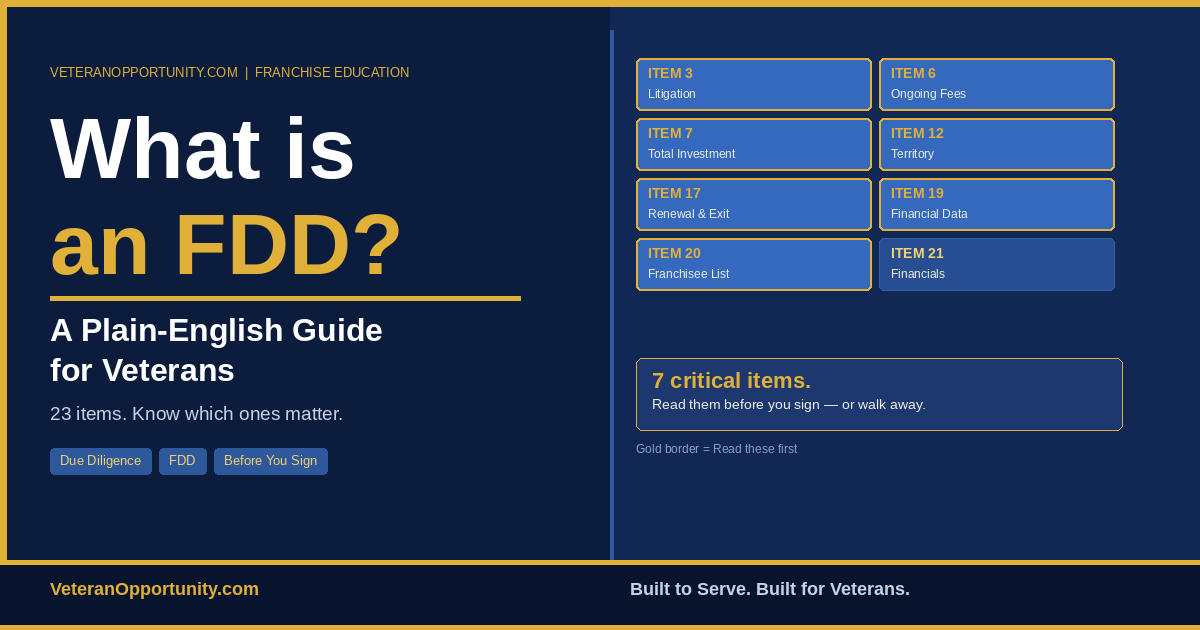
If I had to tell you where to put your sharpest focus, here’s the list:
- Item 3 — Litigation history
- Item 6 — Ongoing fees (this is your real cost of ownership)
- Item 7 — Total initial investment (use the high end)
- Item 12 — Territory protection
- Item 17 — Renewal, termination, and transfer rights
- Item 19 — Financial performance data (or the absence of it)
- Item 20 — System growth, closures, and franchisee contact list
Everything else matters. These items are where deals get made or should get walked away from.
One more thing: hire a franchise attorney
I’ve been in this industry for over 35 years. I’ve seen people try to skip this step. It never ends well.
A franchise attorney — not a general business attorney, a franchise-specific attorney — will review Items 17 and 22 and tell you what the agreement actually obligates you to. The FDD is disclosure. The franchise agreement is the contract. They’re not the same document, and the difference matters.
The cost of a franchise attorney review is a few thousand dollars. The cost of signing a bad contract is everything.
Don’t skip it.
The FDD is your intelligence brief — use it
You didn’t go into a mission without an intel brief. Don’t go into a franchise investment without reading this document.
The FDD won’t make the decision for you. But it will tell you who you’re dealing with, what you’re really buying, what it’s going to cost you, and what your rights are if things go wrong.
That’s not paperwork. That’s power.
If you’re in the process of evaluating franchise opportunities right now, the listings on VeteranOpportunity.com include brands that have been reviewed for veteran-friendliness. The MOS Franchise Finder can help you narrow the field to categories that fit how you’re built.
Start there. Then get the FDD. Then read Items 3, 6, 7, 12, 17, 19, and 20 — and call the franchisees in Item 20 before you make any decisions.
You’ve done harder things than this.
About the author
Lonnie Helgerson, CFE, is the Editor-in-Chief of VeteranOpportunity.com, where he writes about veteran entrepreneurship, franchising, small business ownership, and leadership. A U.S. Army veteran and author, he has founded six franchise systems, served as Chairman of the IFA VetFran Committee, and spent more than 35 years helping businesses grow. He is the author of Five Pennies and Buying a Franchise: Is It Right for Me? He also advises franchise brands through Helgerson Franchise Group.