You spent years learning to execute under pressure, follow a system, and lead people toward a mission. Turns out, that’s exactly what franchising requires.
The military doesn’t teach you how to run a business.
It does something better.
It teaches you how to execute a system. How to lead people who don’t have to like you. How to show up when it’s hard. How to make decisions with incomplete information and own the outcome either way.
That’s franchising.
Not the glossy version in the brochures. The real version — where the model is proven, the playbook exists, and success comes down to one thing: your ability to run it.
Veterans run it better than almost anyone. The numbers prove it.
The stat that should stop you cold
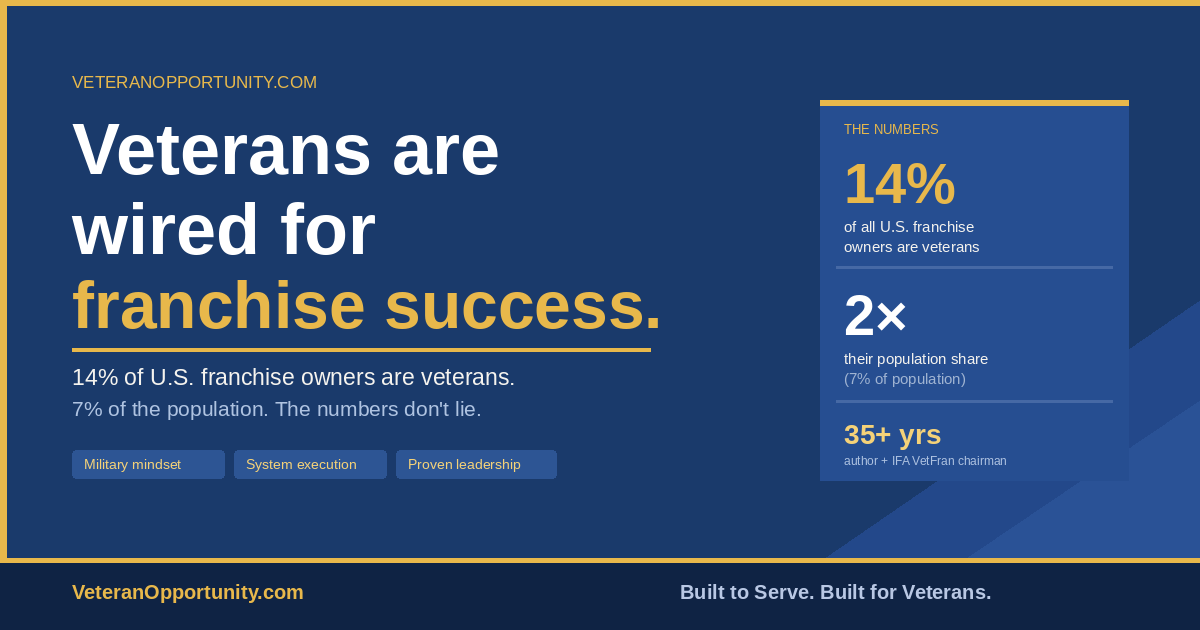
Veterans make up about 7% of the U.S. adult population.
We own 14% of all franchise businesses in America.
That’s not a rounding error. That’s not a coincidence. That’s what happens when a business model built on systems, standards, and execution meets people trained to do exactly that.
The International Franchise Association has tracked this for decades. Franchisors have noticed it too. Ask any franchise development director what kind of franchisee they want, and most will tell you the same thing: give me a veteran.
Why? Because veterans close the loop. They don’t just hear the training — they apply it. They don’t just learn the operations manual — they follow it. They build teams. They hold standards. They execute.
Bottom line: the franchise model was built for people like you.
What the military actually teaches you
Let me break down why veterans and franchising are such a natural fit. I’ve been in this industry for well over 35 years. I’ve founded six franchise systems. I’ve worked with hundreds of veteran buyers. And I’ve watched the pattern repeat itself over and over.
Here’s what you’re bringing to the table — whether you know it or not.
1. You already know how to follow a system
The number one reason franchises fail isn’t bad markets or bad luck. It’s operators who think they know better than the system.
They modify the recipe. They skip the training. They hire their brother-in-law instead of following the staffing model. They go rogue — and the results follow.
Veterans don’t do that.
You spent years learning that the system exists for a reason. That the SOP isn’t a suggestion. That consistency is what creates results. That’s not a constraint — it’s the whole point.
2. You know how to lead people
Franchise ownership is a leadership job. You’re managing staff, setting culture, solving problems your franchisor can’t solve for you.
Military leadership is different from corporate leadership. You led people under pressure. You led people who had no choice but to be there. You figured out how to motivate, delegate, and hold people accountable — often in conditions that would break most managers.
That skill transfers directly. The customers are different. The uniform is different. The mission is the same.
3. You understand that structure is freedom
Civilian entrepreneurs often resist the franchise model because they want control. They want to do it their way.
Veterans understand something civilians often don’t: structure enables execution, it doesn’t prevent it.
You operated within rigid hierarchies and still found ways to lead, create, and solve problems. A franchise gives you the same thing — a structure that handles the guesswork so you can focus on building your business.
4. You’re trained to execute under pressure
Businesses have hard seasons. Slow months. Staffing problems. Tough competitors. Cash flow crunches.
Most first-time business owners fold psychologically when things get hard. They second-guess everything. They panic.
Veterans don’t panic. You’ve been in harder situations than a slow October. You know how to push through, regroup, and keep moving.
That resilience is worth more than any business school credential.
5. You already know what mission-driven looks like
The best franchise owners aren’t just running a business. They’re building something — a team, a reputation, a community presence.
Veterans get that instinctively. You’ve operated in environments where the mission was bigger than any individual. You know how to rally people around a shared goal. That energy shows up in how you hire, how you lead, and how your customers experience your business.
Where veterans tend to win — and where to be careful
Not every franchise is the right fit for every veteran. Let me be straight with you about that.
Veterans tend to thrive in franchise categories that reward operational discipline, team leadership, and systematic execution. Home services — plumbing, cleaning, restoration, landscaping — consistently produce strong veteran owners. Senior care. Fitness. B2B services. These are businesses built on process, not personality.
They tend to struggle more in food service — not because they can’t do it, but because restaurant franchises have notoriously tight margins, high turnover, and complexity that punishes any operator who can’t maintain perfect labor and food cost ratios. Some veterans crush it in food. But it requires honest self-assessment going in.
The honest question isn’t “which franchise looks good.” It’s “which franchise fits how I’m built?”
That’s what the MOS Franchise Finder on this site is designed to help you answer. Put in your military occupational specialty and get a real match — not a generic list. A match built around the skills your service actually developed.
Veterans and franchising: what the research shows
Here’s what the data consistently finds about veteran franchise owners:
They have higher completion rates in training programs. They implement systems faster. They hit profitability benchmarks sooner than the average franchisee cohort.
Franchisors with veteran-heavy systems report lower turnover, stronger unit economics, and better franchisee satisfaction scores. That’s not anecdotal — it’s measurable.
The IFA’s VetFran program exists because the industry figured this out thirty years ago. Over 650 franchise brands now offer veteran-specific discounts and incentives — not out of charity, but because veteran franchisees produce results.
You’re not a charity case. You’re a competitive advantage. The brands on this directory know that.
The Built to Serve commitment
I want to tell you one more thing about why this platform exists.
VeteranOpportunity.com was built on a three-part foundation: helping veterans find the right franchise, helping good franchise brands find the right operators, and giving back to organizations that support the veteran community.
That third leg — we call it Built to Serve — means that when brands advertise here, a portion goes back to organizations fighting veteran suicide such as Stop Soldier Suicide.
This isn’t a side project. It’s the reason I built this.
I served. I’ve spent 35 years in franchising. I know what this business model can do for someone who’s ready for it. And I know what it feels like to make the transition from military to civilian life and wonder what’s next.
Veterans and franchising are a natural match. This site exists to make that connection — and to make sure something good comes from every transaction it enables.
So what’s your next move?
If you’ve been thinking about franchise ownership — or you’re just starting to explore what it could mean for your life after service — here’s where to start.
Use the MOS Franchise Finder. Put in your specialty. See what the data shows. It’s free, it’s fast, and it’ll give you a starting point that’s actually relevant to who you are and what you’re built for.
Then browse the directory. Every brand on this site has been screened for veteran-friendliness. Many offer VetFran discounts. All of them are looking for operators who know how to execute.
You already have the skills. You’ve already done the hard part.
The mission isn’t over. It just changed.
About the author
Lonnie Helgerson, CFE, is the Editor-in-Chief of VeteranOpportunity.com, where he writes about veteran entrepreneurship, franchising, small business ownership, and leadership. A U.S. Army veteran and author, he has founded six franchise systems, served as Chairman of the IFA VetFran Committee, and spent more than 35 years helping businesses grow. He is the author of Five Pennies and Buying a Franchise: Is It Right for Me? He also advises franchise brands through Helgerson Franchise Group.